- 最終更新日:
“Linen Supply” Is Added to the Specified Skilled Worker System


ゼンドラ(株)は今後、英語でも情報を発信してゆく予定です。本記事は初回テスト版として ご紹介しました。定期購読や全誌の記事が読める『ゼンドラオンライン』 にぜひご登録 ください。
Move Addresses Labor Shortages and Vision for Industrial Sustainability
Following a Cabinet decision on January 23, 2026, “linen supply” was added as a new field to the Specified Skilled Worker System on June 1. It is now possible to hire foreign workers in the linen supply sector—covering the entire process from receiving and sorting linens used in hotels, ryokans, hospitals, and nursing care facilities, through washing, drying, finishing, inspection, bundling, and shipping. The government has also designated linen supply as a field eligible for the “training-based employment” system, making this a significant policy revision for future workforce recruitment strategies.
The current Specific Skilled Worker System covers fields such as nursing care, building cleaning, construction, manufacturing, lodging, agriculture, and food service. With the 2026 system reorganization, linen supply, logistics and warehousing, and resource recycling is added, bringing the total number of eligible fields to 19. The Japan Immigration Services Agency is promoting the acceptance of foreign workers under the Specific Skilled Worker System by defining, for each field, the “status of labor shortages” and “standards for required personnel.”
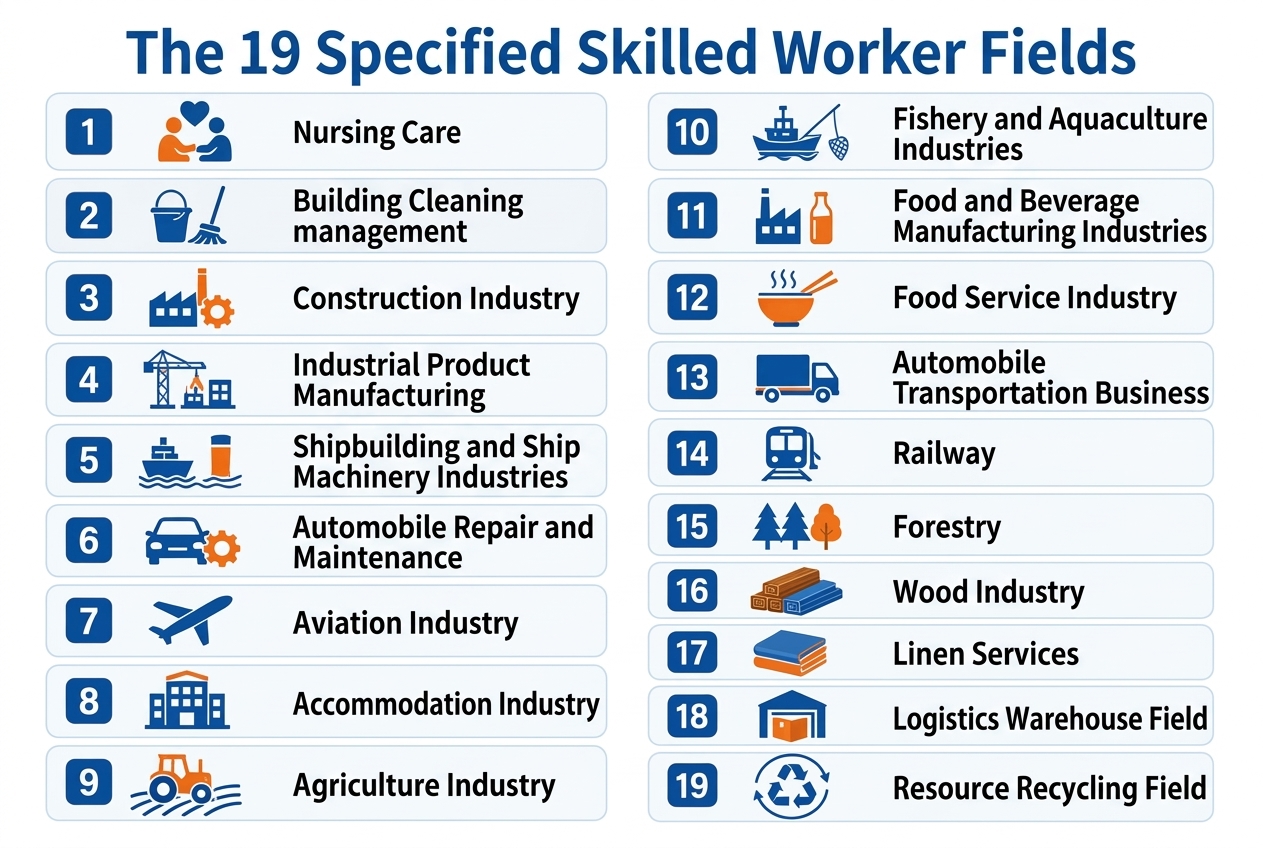
Three new fields have been added to the 16 existing Specific Skilled Worker fields.
Sectors with Severe Labor Shortages Added
The three sectors added this time share a common characteristic. In each case, labor shortages are severe, and it has been determined that future demand cannot be met solely through securing domestic workers or improving productivity. In the logistics and warehousing sector, the system covers tasks such as the receipt, dispatch, and storage of cargo within warehouses, where automation and mechanization are advancing to reduce labor requirements and save manpower. In the resource recycling sector, securing workers for waste processing and resource recovery is also a major challenge.
The inclusion of the linen supply sector is also driven by a severe labor shortage. According to the “Policies on the Operation of the System Concerning the Specified Skilled Worker Status of Residence in the Linen Supply Sector and the Operation of the System Concerning Training and Employment” compiled by the Immigration Services Agency of the Ministry of Justice, the effective job openings-to-applicants ratio for fiscal year 2024 is 3.71. Furthermore, it is estimated that by fiscal year 2028, while the number of workers needed will reach 119,800, the actual workforce will remain at around 99,700, resulting in a labor shortage of approximately 20,100 people.
Filling the Domestic Labor Shortage with Foreign Workers
However, the government did not intend to fill the 21,000-person shortfall simply by hiring foreign residents. Rather, a close reading of the policy document reveals that foreign workers are positioned to fill only the “final gap.”
According to the government’s estimates, productivity improvements are expected to alleviate the labor shortage by approximately 5,200 people and securing domestic workers by approximately 7,200 people. Even so, a shortage of approximately 7,700 workers is estimated, and the policy is to fill this gap with foreign workers under the Specified Skilled Worker and Training-Based Employment Systems. The projected number of foreign workers to be accepted over the five-year period from fiscal year 2024 to fiscal year 2028 is 7,700, broken down as 4,300 under Specified Skilled Worker Category 1 and 3,400 under the Training-Based Employment System.
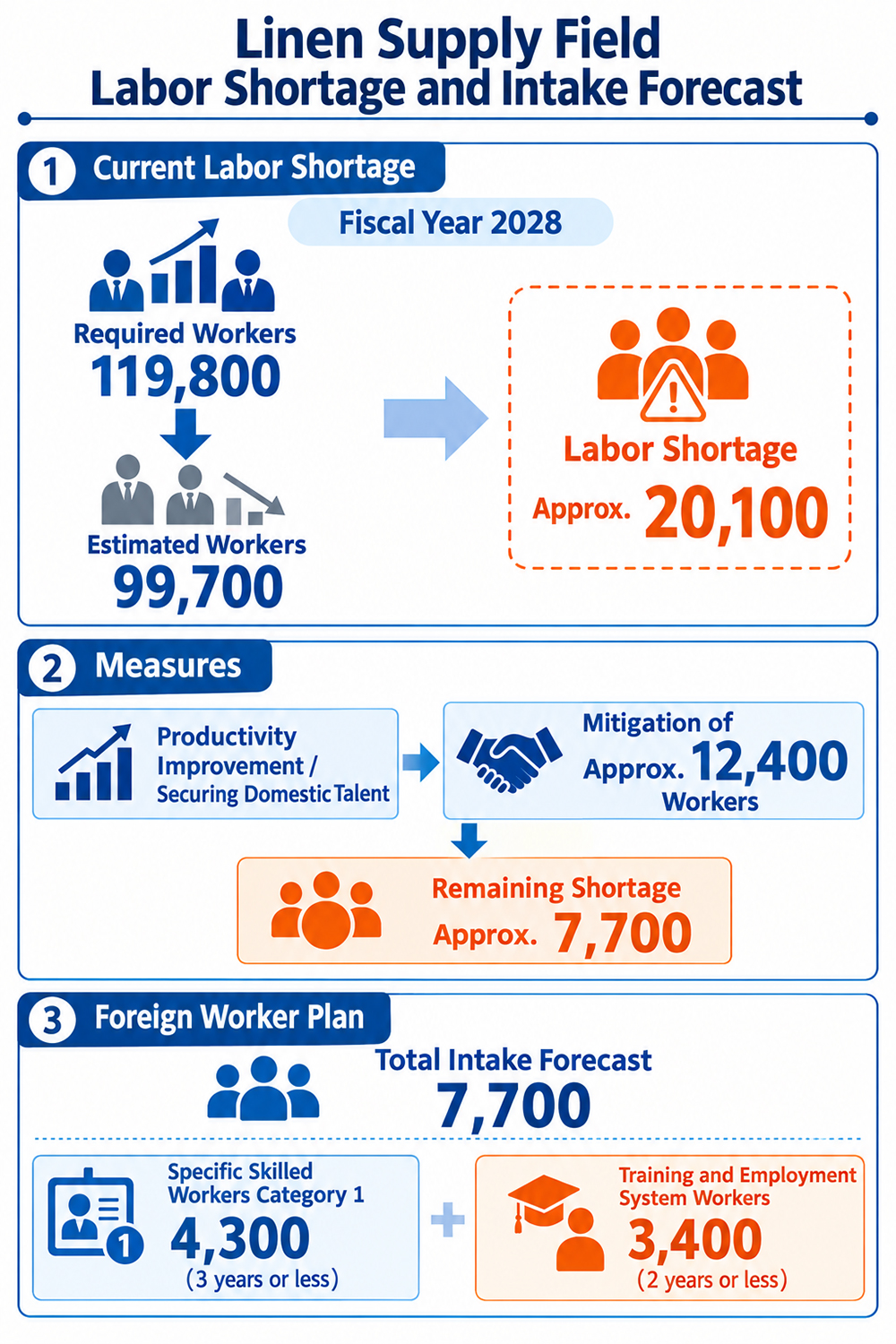
The plan is to address the labor shortage of approximately 7,700 workers by bringing in 4,300 workers under Specific Skilled Worker Category 1 and 3,400 under the Training and Employment System.
This system is not simply a matter of “bringing in foreign workers because Japan is short-staffed.” The approach is to first advance initiatives such as equipment upgrades, layout changes, operational efficiency improvements, labor-saving measures, the recruitment and retention of domestic workers, and improvements in working conditions—and then use foreign workers to fill any labor shortages that remain despite these efforts.
What deserves attention is the social role of the linen supply industry. Against the backdrop of projected continued demand for lodging—driven in part by the increase in foreign tourists visiting Japan—the government has identified securing personnel for the linen supply industry, which supports the operations of hotels and ryokan, as a key challenge. Furthermore, since the industry handles linens used in hospitals and nursing care facilities, it also serves as an industry that supports public health. It is positioned not merely as a “laundry service,” but as a key component of the social infrastructure that underpins tourism and healthcare.
Specified Skilled Worker and Training-Based Employment Systems for Linen Supply Services
Under this system, we must not overlook the perspective of “training”. While Specified Skilled Worker Category 1 is a system designed to accept workers with specific skills who can contribute immediately, the Training-Based Employment System is designed to develop and secure talent by allowing workers to acquire skills on the job. By making the linen supply industry eligible for both systems, the plan is to secure foreign workers not merely as “temporary labor”, but as personnel who will support the industry in the long term while acquiring skills.
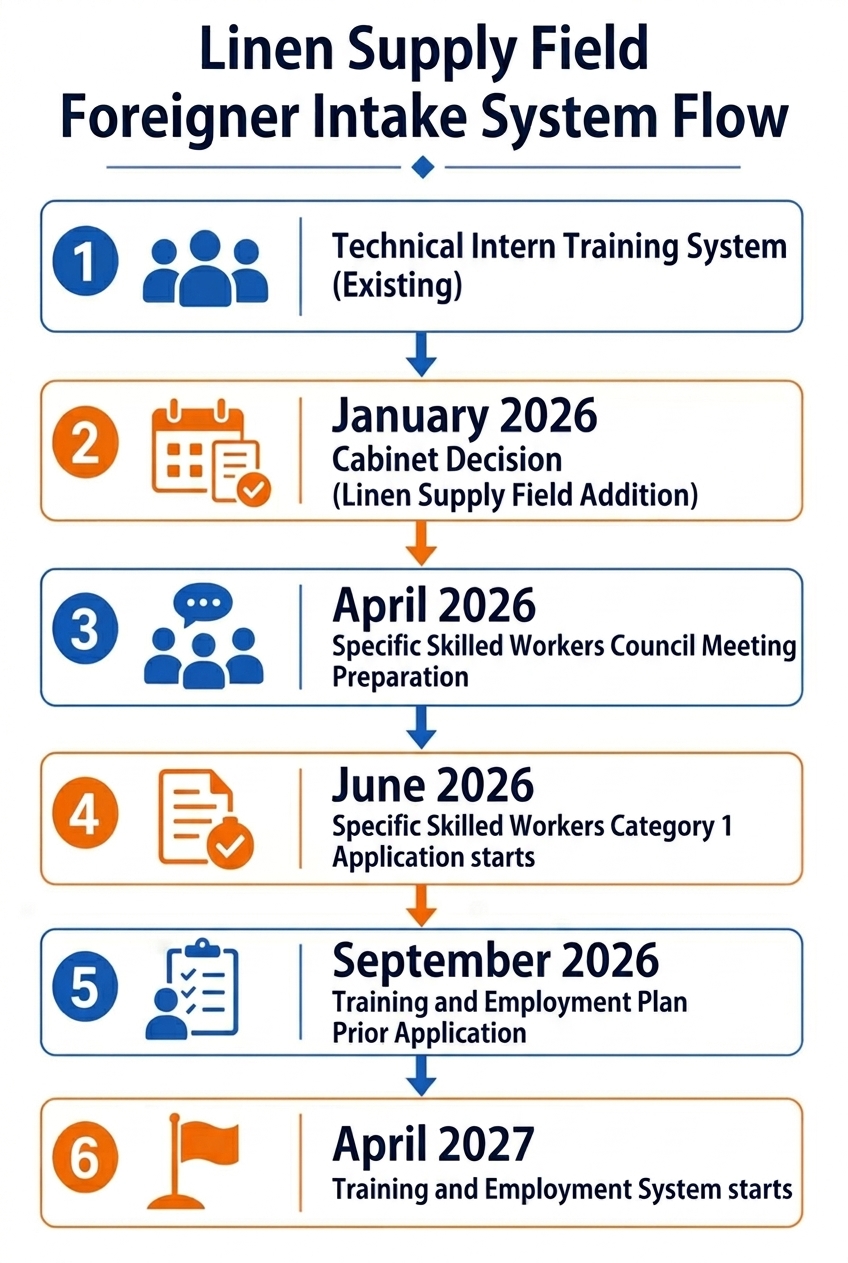
The Technical Intern Training System is scheduled to be abolished on April 1, 2027, and the Training and Employment System is set to begin.
In particular, within the linen supply sector, a pathway has been established allowing individuals in the “cleaning and linen finishing” category of the Technical Intern Training System to transition to the Specified Skilled Worker System if they meet certain conditions. This represents a significant change for linen supply businesses that have traditionally accepted foreign technical interns.
With these regulatory reforms, the linen supply industry has gained a new means of securing personnel. However, the significance of this goes beyond simply hiring foreign workers. What the government has outlined is the ideal future model for industry: “Increase productivity, secure domestic workers and improve their working conditions, and supplement the workforce with foreign workers only where necessary.”
How will the 7,700-person cap on admissions be utilized in actual workplaces? How will the retention of foreign workers change work practices, facilities, and workforce development at factories? And to what extent will the Specified Skilled Worker System contribute to improved productivity and working conditions in the linen supply industry?
The Training and Employment System is scheduled to begin in the linen supply sector on April 1, 2027. However, as this system is still in its early stages, we intend to continue closely monitoring its future implementation and the resulting changes on the ground.
 定期購読のお申し込みはこちら